Monday, September 6, 2010

Blogging the Booker 10: The Stars in the Bright Sky

Alan Warner's novel The Stars in the Bright Sky posed a new problem for me in my trip through this year's Booker longlist - it's the sequel to a book I've not read. I toyed with whether I should prepare for this one by reading its predecessor (The Sopranos - and no, not that one), but decided that I should just judge The Stars in the Bright Sky on its own merits, as a standalone.

That choice also carried the benefit of being easier.

Initially, however, I was worried that I was going to be lost without the context of the first book, as I had no idea who any of the characters were. But, having now finished The Stars in the Bright Sky, I can attest that not having read The Sopranos wasn't really a barrier. There were some clear allusions to the events of that book, but from what I can tell it was set a couple of years earlier than the events of its follow-up, and the two are largely unrelated in a plot sense. (Obviously those who have read both will get more out of the second, though.)

Anyway. The Stars in the Bright Sky is about six young - mostly Scottish - women setting off on a quick, cheap holiday together. Five of them were friends at school, but two have now moved away from their small-ish Scottish town to study, and one of them brings her flatmate along for the trip. Plans constantly go awry, tensions between them all are revealed, and secrets are uncovered. Warner captures the dialogue well, and the book is mostly a quick & easy read.

In our group, we have a group of contrasting types. The unofficial leader - certainly the planner - is Kay (one of the two from the original five to have moved away). The other student - who went all the way to London - is Finn, and her mysterious friend Ava (whom the others haven't met beforehand) drives much of the narrative action. Of the remaining three, Manda is the novel's clearest-drawn character - a loud, under-educated, frequently stupid &/or insensitive single mother. The other two, regrettably, are not all that distinct (one is a talented singer, the other is not) - and indeed often seem largely interchangeable. Granted, that may have been deliberate on Warner's part - to outsiders, it's probably quite common to see a group of friends & identify the organised one (Kay), the quiet & thoughtful one (Finn) and the loudmouthed one (Manda) and then the rest sort of blur together.

Nonetheless, for me, that was one of the failings of The Stars in the Bright Sky - two of the six characters are not all that interesting, and one of the others is perhaps too much of a lout, constantly saying awful things, malapropising on almost every page & fitting too easily into the role of the insecure type who acts out in the most obvious of ways. The other problem I have with The Stars in the Bright Sky is possibly a little unfair. As I say, it was an easy & enjoyable-enough read, but I did frequently wonder why it merited Booker longlisting. The Stars in the Bright Sky seems to me to be a fairly straightforward novel about a group of friends who set off on a holiday. The writing, while rarely clunky (although it sometimes was) didn't excite me much, & there didn't seem to be much of a larger point or anything going on. Again, I realise this is unfair - it's more of a criticism of the Booker longlist than of the book itself - but I'd be very surprised if Warner's book made the shortlist.

Next: tomorrow, the shortlist is announced. I'll do a quick post before then, summarising my thoughts so far & tipping what I hope the shortlist will include from the ones I've read to date. After that, I'm at the mercy of my fellow patrons of the North Sydney library, but hope to be able to get one or two of the remaining five by the end of this week.

Friday, September 3, 2010

Blogging the Booker 9: Room

As with The Long Song, Room's main of several triumphs is its narrative voice. Emma Donoghue's novel is one of the most distinctive & original books I've read in a while, combining both a fascinating central premise with a well-realised voice.

Jack, who turns five at the start of the book, & his mother live in a small room, which also forms the limits of their world. They never go outside. For Jack, the world is divided into the Real (him, his Ma, and everything in their small room) and TV (things he sees on television). He recognises that there is an Outside, but his mind doesn't really process how that works or what that Outside entails. Therefore, from Jack's perspective, there exists only one of everything - the one that is in their room. Thus, as he narrates the story, he says things like "Ma leans out of Bed to turn on Lamp".

Why these two people confine themselves to Room is only gradually revealed. This is a novel that it would be very easy to spoil, so I'll avoid plot details beyond the premise as outlined above.

Jack's voice, as narrator of this story, is pitched perfectly, as Donoghue gets deep into his skin & observes what it must be like to have spent one's entire (albeit young) life in one small room, with only one's mother and the television for company. As he grows, his mother tries to explain what Outside is actually like, but Jack is fundamentally unable to understand what she tells him - he has no frame of reference for the idea that there are things and people beyond the two of them. Room is thus largely about perception, and perhaps also about how our version of the world is a consequence of how & where we were brought up.

Again, I won't reveal any details, but I will say that the story developed in an interesting way - for a while I was concerned that the basic premise would never really be explained satisfactorily, which would have significantly hampered my enjoyment of the book, I think. But instead Room makes the most of its ideas, filling in some backstory while also moving forwards in the narrative. It's also quite a quick read, despite how it might sound.

So, another success on this longlist for me! I hope Room makes it through to the shortlist (announced next week) - it certainly deserves to do so. Another author of whom I had previously been unaware, I'll certainly have to look into some of Donoghue's earlier novels (Room appears to be her ninth book, according to the list inside). As I've said before, the discovering of new (to me) novelists is one of my favourite things about following the Booker Prize each year - even if I'm not always happy with the winner, there's usually something of interest brought to my attention.

Next time: All the Stars in the Bright Sky, by Alan Warner.

Tuesday, August 31, 2010

Blogging the Booker 8: The Long Song

Andrea Levy's The Long Song is a surprisingly snappy read, given that it deals with fairly weighty topics. The Long Song is a story of Jamaica at the end of the slavery era, and in the immediate aftermath of the British government's decision to free the slaves on the Carribean island.

A couple of years ago I read & enjoyed Levy's previous novel, Small Island, which also dealt with the relationship between Britain and its former colony, albeit at a later point in that history. So I was looking forward to The Long Song, but was still pleasantly surprised by how entertaining and interesting it was. Partly that's because I'm a bit of a sucker for post-colonial novels, but mostly it was due to Levy finding both an interesting (& under-fictionalised) time & place for her story, and a memorable set of characters.

I seem to be spending a fair bit of time in these reviews discussing narration, but the question is one of the core ones to the success of a novel, and it's one of the best elements of The Long Song. Our story is introduced by Thomas Kinsman, who tells us that his mother has a story to tell, & she agrees to tell it because he promises to make it into a book when she's finished. For the rest of the book, she tells us the life of July, a slave born into a sugar plantation, plucked from her mother at a young age and assigned to serve the lady of the house (the owner's widowed sister). From this perspective, our narrator (whose actually identity is not confirmed until more than 100 pages in) focuses on the events leading up to the freeing of Jamaican slaves, and the violence which followed. July becomes more entangled in the family's affairs, and Levy also makes the point that the difference between slavery & freedom is not always as great as we might hope - the Jamaican former slaves didn't all suddenly become happy & prosperous just because they were no longer slaves. Exploitation can adapt itself to new circumstances, as history has reminded us on many occasions.

Yet despite the oft-grim events & themes of The Long Song, our narrator's voice (she reminds us of her presence every few chapters, emphasising that this is her version of this story and that different versions exist) carries the book along at a constant clip. This novel has several virtues, but Levy's deft handling of the narrative voice is chief amongst those. The Long Song is another book I'm hoping will reach the Booker shortlist, and I think it's probably a strong contender for that, and perhaps even to win.

Next time: The Room, by Emma Donoghue.

Friday, August 27, 2010

Twilight Through The Ages

Those who have read my widely tolerated series (via Facebook) on Stephenie Meyer's Twilight series will know that I had very little to say in praise of those books. The one thing I did think was worthwhile about them was the cover design, which we've certainly seen a lot of, but is nonetheless actually pretty striking.

However, for such recently published books, the Twilight series seems to have been published in more editions than the Bible. My assumption is that the publishers have seen an opportunity to get people to continually re-buy the same books, just so they can have every possible edition of their beloved story*.

First, we had the standard-issue hardcovers/softcovers, with the iconic covers:


Simple, direct, and not bad, particularly when compared to what was inside...

Next up, we had the same covers, but with 'Special Edition' plastered across the top of each:
The main difference with the Special Editions was that they had either the first chapter of the next book or - in the case of the copy of Twilight I read - a chunk of an apparently forthcoming version of the story told from Edward's point of view.

I'll give you all a moment to absorb the ramifications of that...


Next, and quite remarkably, we had the red-edged versions. Again, same covers, but the pages' edges (top, sides & bottoms) have been coloured red through some miracle technology:
It's worth noting that, for a while, the top ten books sold in Australia each week included both the standard paperbacks of the series and the red-edged editions. There were certainly quite a few weeks where different versions of these four books made up 70 or 80% of the top ten books sold in Australia. (I believe the other two were Dan Brown's latest and whatever thing James Patterson had most-recently signed his name to.)

There was, of course, also box-set releases of all of these editions once all four books had been published, collecting previously released books into a piece of flimsy cardboard.

By this point, of course, the movie versions were beginning to roll out. And if movie adaptations of popular books exist, can movie tie-in editions be far behind?

No.

What's interesting about these editions - other than how bland the covers are, even by movie tie-in edition standards - is how relatively uncommon they were. The standard/special/red-edged editions of each book continued to be much prominently displayed in bookstores

and these tie-ins seem to have been released mostly to capture the re-buy market. They also came, as you might have noticed, with an Exclusive Poster Inside!, further implying that they were seen as a collectors' item, rather than as a normal way to buy the books. (Breaking Dawn is yet to come, of course.)

(By the way, that photo of a pile of Eclipses was taken by yours truly on his phone at Dymocks in Broadway back in February this year.)

At some point, I also noticed this little boxset release:
A set of journals, with blank pages inside the four book covers, all in a neat package. Presumably so that fans could write their own swooning fanfic. (On that note: Stephenie Meyer may be the first person to write her own fanfic. Also, how great would it be to read any of my genre revisitations of Breaking Dawn in one of those notebooks?)

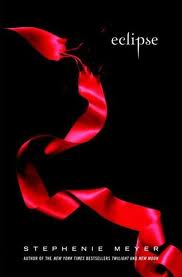
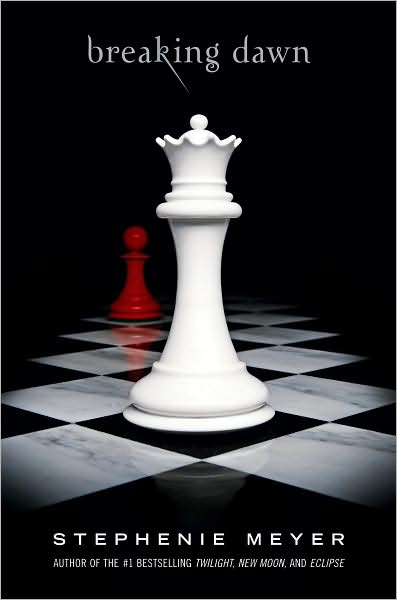
But the latest editions - and the inspiration for this post - are possibly the strangest:

How awful do those look? Breaking Dawn in particular has been completely ruined, but they're all vastly inferior to the original black versions. (Although, I do give them a little credit for the choice to remove all text from the front cover. That works well here, because the existing images are so well-known.)

Speaking of ruining things, other publishers also tried to capitalise on the Twi-session sweeping the world, with this remarkable piece of horror:


Clearly, the only way to shift a few copies of Emily Bronte's little-known and mostly-forgotten novel Wuthering Heights was to do a cheap knock-off of the Twilight books & plaster 'Bella & Edward's Favourite Book' across the cover.

On that cheery note...


* Full disclosure: there are several books which I own in multiple editions, simply because I liked a re-release. Penguin in particular are very good at repackaging their catalogue in irresistible new editions. So I understand the psychology, to an extent. But I would point out that, while I've done this for a handful of books, they're all approximately 800 millions times better, in both content & design, than Twilight.

Wednesday, August 25, 2010

Blogging the Booker 7: C

Tom McCarthy's first novel, Remainder, was published a few years ago to great acclaim. Zadie Smith, a favourite of mine, described it as 'one of the great English novels of the past ten years'. I personally liked it, but also thought that level of praise was a bit over-the-top - it was an interesting novel, but perhaps because I read it well after all the hype pushed it to 'instant classic/future of the novel' status, found it a little underwhelming.

So I approached C with a mixture of interest & trepidation - interest to see what this talented young author would do, and trepidation that again I would miss the point of it. And, to be honest, I found C a bit of a mixed bag. Parts of it bored me & proved to be difficult to really get into, and other parts I thought worked really well.

C is the story of Serge Carrefax, born at the turn of the 18th century in England. The first (of four) sections follows his childhood and youth, focusing particularly on his father (a pioneer in radio/telegraph transmissions, and the founder of a school for deaf mutes) and his older sister (a talented scientist herself as a teenager). The second section jumps forward a couple of years from the end of the first, as Serge becomes a radio operator in fighter planes during the first World War. After the war ends, section three is about post-war London, in which Serge is an architecture student who also meets a girl, cultivates his army-initiated drug habit, and investigates a medium claiming to connect people with their sons/brothers who died in the war. As this section ends, Serge is offered a job in Egypt, working on England's attempts to establish a radio network.

The first section I found mostly interesting, if occasionally quite slow, and the second I never really got into. Admittedly there has been other things going on in the last week or so, but I still found myself really struggling to maintain interest in C - either not reading it at all on some days, or reading a few pages before putting it down to do something else. I'll be the first to admit that this is perhaps my fault and not McCarthy's, but nonetheless, the first two sections of C had me convinced that I'd struggle to finish it. However, the third section is wonderfully well-done, and gave me the impetus to continue. (The final section is also quite good - not as much as the third, but better than what had come earlier.)

So, as I say, I have quite mixed feelings about C. I still think the third section works very well, and could almost stand as a long-ish short story on its own, and the first & last also had their moments. But overall I can't really say that I hope C proceeds any further in the Booker prize. (I also can't help thinking that 'Serge' is a bit too obvious a name for the protagonist of a novel that is largely concerned with electricity & radio...)

(Oh, one final thing: C does have, in my opinion, the coolest cover of the books I've read from this list so far. The cover itself is black with white dots and the big letter 'C'; the dustjacket overlay is clear, and includes all the swirls & the author's name you can see above. Very cool.)

Next up: Andrea Levy's The Long Song.

Thursday, August 19, 2010

Blogging the Booker 6: The Thousand Autumns of Jacob de Zoet

A confession to begin: David Mitchell is one of my favourite living authors. I have loved each of his novels to date, and think he is one of the most talented & interesting authors writing in the English language so far this century. So I approached his latest, The Thousand Autumns of Jacob de Zoet, with a fair degree of anticipation, and am perhaps not the most objective reviewer of this book.

(But, that said, subjectivity is good when reviewing things.)

Mitchell's first three novels - Ghostwritten, Number 9 Dream & Cloud Atlas - were highly formal works, with complex uses of form. Cloud Atlas really reached the zenith of that style, in a way - told in six voices, with each section reflecting back on the one before it, so that the diary which formed the first part was read by a character narrating the second, and so on. And then halfway through, the book reversed upon itself, working backwards in time through the six sections again. Each of the sections stood up on its own, but the combination of them all was a thrillingly eye-opening experience.

Anyway, this review is not about Cloud Atlas. The book that followed it, and preceeded this one, Black Swan Green, was still episodic in nature but also signalled a more personal approach for Mitchell. And with Thousand Autumns..., formal experimentation takes a definite backseat to character.

Set in Japan at the end of the 18th and start of the 19th century, Thousand Autumns... explores the relatively unknown world of the first Europeans to have significant contact with the Japanese. At a time when Japan was incredibly isolated from the rest of the world, the limits of their outside contact was via a small island, Dejima, off the coast at Nagasaki. The Dutch traders are allowed only on the island, not onto the mainland itself, and much of Thousand Autumns... is about the somewhat-strained relations between the two cultures.

Our protagonist is Jacob de Zoet, a promising young clerk sent to Dejima to investigate allegations of corruption amongst the senior Dutch merchants. This, of course, does not make him popular with his countrymen, but he remains dedicated to the task while also forming links with Japanese translators and officials. In the novel's second section, the scope widens and Jacob receeds into the background as other characters' stories are told, but then the focus returns to Jacob in the final sections, while retaining other perspectives (& introducing new ones - Mitchell hasn't completely abandoned the multiple-narrator style that characterised Ghostwritten and Cloud Atlas). The second and subsequent sections explore a mysterious convent in the country and its relationship with what goes on in the trading town. As seems to be a theme of this year's Booker longlist, narration is omniscient third-person, and different sections/chapters are told from the perspective of different characters.

The Thousand Autumns of Jacob de Zoet has an intricate plot, and I don't really want to say too much more about that. I will say, however, that even given my high expectations and hopes, I loved this novel. It may not have the breath-taking pyrotechnics of Cloud Atlas, but in it's own quieter way, it's just as impressive a novel.

Mitchell has now been long- or short-listed for each of his novels. I fully expect Thousand Autumns... to make the shortlist, and am hoping that this can be the one for which he finally wins.

Next: Tom McCarthy's C, which I started reading this morning.

Monday, August 16, 2010

Blogging the Booker 5: Skippy Dies

Skippy Dies is a difficult book to categorise. It's a boarding school novel, it's a comedy, it's a tragedy, it's a reflection on the ways in which all lives and all stories intersect and affect each other.

It's also very good.

Paul Murray's second novel revolves around the Seabrook College for Boys in Dublin. There's a large cast of characters, including Daniel 'Skippy' Juster, his friend & room-mate Ruprecht Van Doren, their History teacher Howard 'The Coward' Fallon, object of Skippy's affection Lori (from the girls' school next door) & school bully/drug-dealer Carl. There are more, of course, in this well-populated novel, but those are the ones whose perspective we see the most.

(Like The Slap, Skippy Dies is told by an omniscient third-person narrator, but rather than presenting the different POVs one after the other, short chapters jump from one to another throughout. The narrative voice, despite being third-person, does change noticeably depending on whose chapter it is, particularly in the cases of Lori and Carl.)

Anyway, a novel called Skippy Dies features a lead character called Skippy, so there's at least one thing you know going in. Murray takes care of that by having the death scene as a prologue to the rest of the book, and then steps back in time to how & why we got there. Skippy and Ruprechet are unusual students - the latter in particular, an enormously fat genius interested in string theory and the idea that our dimension is merely one of eleven. The pair of them, and their larger circle of friends, spend most of the first two-thirds of the book worrying about the sorts of things all teenage boys do: school, girls, parents, theoretical physics. Skippy is fascinated with Lori, who is in turn attracted to the dangerous (& probably psychopathic) Carl.

Meanwhile, Howard, a former student at Seabrook who has returned there as a teacher (somewhat against his will), is also struggling to get his life in order. Stuck in a relationship that bores him, and wondering what the point of his life is, he tries to make History interesting for the boys. In doing so, he discusses one of the major themes of Skippy Dies - that history as written in textbooks is only one version of any given set of events, and that observing the same events from a different perspective is bound to give an entirely different story. (The example he uses is the First World War, which Ireland has largely written out of its own history, but also pointing out that histories which reflect the war's geopolitical purposes ignore the stories of the young men actually doing the fighting.)

Murray makes this theme not just his character's philosophy, but also the structure of the book as a whole. By switching between the different characters every few pages, we gain a better understanding of each of them - a gradual reveal of not just plot & character, but also some larger points about history and people's lives.

Skippy Dies is an intriguing book. It's fairly long (660 pages in paperback), but moves quickly throughout. The changing character POV is an effective technique not just for the reason I've just discussed, but also in terms of pacing - by constantly cutting between characters, we're always tempted to read just a little bit more to see whose chapter comes up next. Murray has a fine ear for dialogue, particularly that of his teenage characters, and maintains a light touch even in the book's tragic sections (of which there are several).

The Booker Prize has not traditionally had much time for 'comic' novels, and I do wonder whether an ostensibly comic novel set in a school is a likely winner. I do hope (at this point in my reading, anyway!) that Skippy Dies makes it through to the shortlist at least, since I think it's worthy of a wide audience. Even if it goes no further, I'm glad I had it brought to my attention.

Next up: David Mitchell's The Thousand Autumns of Jacob de Zoet.